
The Journey of Army Veteran, Wheelchair Tennis Player and Coach Paul Walker
For retired U.S. Army Captain Paul Walker, service is a commitment that has shaped his life, from leading soldiers in the U.S. Army to helping generations of tennis players discover what they are capable of achieving.
Walker was commissioned as an Army officer in 1988, drawn to a life that combined physical challenge, leadership and a sense of purpose. By 1994, he was commanding Charlie Company, 17th Engineer Battalion at Fort Hood, Texas. That August, while doing some sport parachuting on base with some of his lieutenants, Walker was involved in a serious parachuting accident. He broke both bones in both legs below the knee, but more concerning was the L1 burst fracture and fractures of his L2 & L3 vertebrae, which led to a spinal cord injury and paralysis. It took almost a full year of intensive recovery and rehabilitation for him to regain some normalcy in his life. He was medically retired from the Army in July of 1995, and a new life as a full-time wheelchair user began.
Almost three years after his accident, the Eastern Paralyzed Veterans Association invited Walker to a tennis camp, where he discovered wheelchair tennis. That introduction to a familiar sport launched an extraordinary journey. He rose to No. 31 in the world as a wheelchair tennis player before turning his competitive drive toward coaching, eventually becoming a USTA national coach, mentoring world-class athletes and helping expand opportunities for players at every level.
“I've often felt like I’ve lived two distinctly different lives,” Walker says. “Being injured at 30 years old, I had lived a wonderfully full and active life to that point. My type of injury forced a uniquely different way of living. Both have been incredibly rewarding, but very different.”
Now, nearly three decades after discovering wheelchair tennis, Walker continues to find purpose on the court. His contributions were recognized in 2026 with his induction into the inaugural Wheelchair Tennis Hall of Champions, part of the sport's 50th anniversary celebration.
In honor of Veterans Day, Walker shared a collection of photographs spanning his military career, journey as an athlete and years as a coach. In the reflections that follow, Walker tells that story in his own words, recalling the people, experiences and moments that have defined his journey, and the enduring connection he sees between serving his country and serving the sport he loves.

1994
That's my company command picture from 1994, Captain Paul Walker, company commander of Charlie Company, 17th Engineer Battalion, 2nd Armored Division at Fort Hood, Texas. I was 30 years old there, and that was around April, when I took command.
I had a mentor who had a very full, successful career as an army officer, and I thought, "Wow, that's what I need to be doing." It was an incredibly active lifestyle with purpose and service, and I've always had a patriotic nature. I was commissioned in 1988 at Officer Candidate School, Fort Benning, Georgia.
My first duty assignment was in Germany at the end of the Cold War and I deployed to Operation Desert Storm from there as well. I believe I had found my calling in life, so in a lot of ways, this is kind of where the story starts.

1994
This picture was taken during a field training exercise at Fort Hood. This type of training would be equivalent to practice matches in tennis. Some of these exercises are high intensity, others less so. Based on this picture and my seemingly laid-back look, I’d say it was less so.
I think one of the great lessons I learned in the army was establishing and trying to maintain high standards in training. Good coaches have high standards and teach players to rise to those standards to achieve their best results. Another correlation between military leadership and coaching is the establishment of trust between a leader and their soldiers and coaches and their players.

1994
My lieutenants, first sergeant and I are standing tall and looking good in our dress blues. The first sergeant was the highest-ranking noncommissioned officer in the company and really my right-hand man. The other four guys were my lieutenants and platoon leaders in Charlie Company.
That was our leadership team. We were a group of highly dedicated, highly motivated men. We all believed in the mission to serve this country and do good things. Some stayed in the military and had really good careers, some got out, and I've stayed in touch with a couple of them all these years later. They represent the best of the best and I'm proud to have been associated with that group.
1997
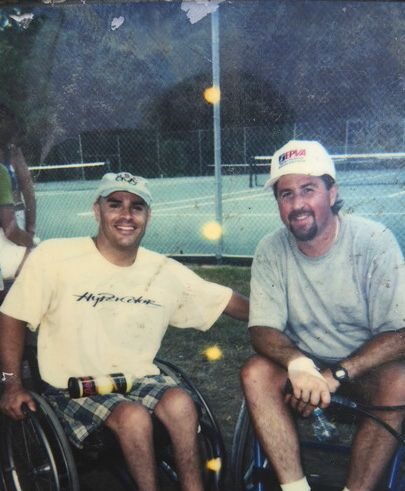
I was first introduced to wheelchair tennis at a camp at Flushing Meadows in June of 1997 through the Eastern Paralyzed Veterans Association. Quite frankly, I didn't even know wheelchair tennis existed, but I had played tennis growing up, and I started thinking, "Could I hit tennis balls with Vincent or Dan again?" Could I go back out and play with some of the friends I'd played with before my injury?
The camp was led by Randy Snow, a true legend in wheelchair tennis, and when I saw the sport, I thought, "Yeah, this is it." That picture is from my first tournament in Albany, New York, with Eric Pierce, one of the first guys I started hitting with. I was playing in my everyday wheelchair. Basically, bungee cord the feet and go to work. But I couldn't have been happier.

1998
Now I'm in an actual tennis chair (my first Quickie), one of those three-wheelers we used back then. This was at the Wheelchair US Open in Irvine, California, and I was still coming up through the pipeline, playing in the B division, which I won that year.
You can see the EPVA shirt, and that means a lot to me. They did a really nice job of sponsoring athletes and helping us get to tournaments. When you think about it, a veterans organization put a veteran on a path that really formed a career. I probably don't stop and think about that enough. I never anticipated where all this would take me, but I'm forever grateful.

2002
By now I had moved up the ranks and become an Open player and an internationally ranked wheelchair tennis player. I ultimately reached No. 31 in the world in 2005.
This is Arthur Ashe Stadium. I believe this was at the tournament created in memory of Jana Hunsaker, who had been instrumental in building the wheelchair program at the National Tennis Center. So that picture represents another step in the journey, going from a guy who didn't even know wheelchair tennis existed to playing internationally and in a venue as exalted as Arthur Ashe Stadium.

2002
My coaching career started here. Dennis Mason, a Vietnam veteran, double amputee and one of the best humans I have known, was a teacher at George Jenkins High School in Lakeland. We had played some wheelchair tennis together and one day he called and asked if I'd be interested in coaching the girls tennis team. I thought about it and said, "Yeah, you know what? I think I would really enjoy that."
I ended up coaching high school tennis for 13 years. It’s where I cut my teeth as a coach and started immersing myself in the world of coaching while I was still playing competitively. At the time I think there was something unique about a guy in a wheelchair coaching able-bodied high school players. We had a lot of success, won some championships, but my greatest recollection from those years was coaching a bunch of really wonderful young ladies.

2004
I got to coach alongside the legend Randy Snow. He was one of the most inspiring guys I have ever met and really impacted my desire to be a coach! He started me on my wheelchair tennis journey and later became a good friend. He passed away in 2009, but his contributions to our sport endure. We’re in Austin here. Man, that Texas sunset was something to behold!

2011
Somewhere along the way I started coaching a great group of USTA league ladies here in Lakeland. They affectionately labeled themselves the Paul Walker Tennis Association, and I actually formed the PWTA, LLC (which I still use to this day). It began with a couple of lessons, then a team clinic, and we ended up staying together for close to 10 years. They were a very close group of friends, and my wife Terri played on the team as well.
This was at their 5.5 Combo championship, and it's just one of my all-time favorite pictures. Friday morning clinics, private lessons, a lot of tennis and a ton of fun. I cherish the memories of time spent with the OG PWTA! It was another completely different space in tennis that I was fortunate to operate in.

2016
The blonde kid on the far right is Casey Ratzlaff, who is currently our No. 1 ranked men's player, and in the middle is Chris Herman, who for a time was our No. 1 ranked junior boy and is now a broker with Morgan Stanley. Look right behind Chris. Can you tell who that is? It's Carlos Alcaraz!
This was at the opening ceremony for the Les Petite A’s tournament in Tarbes, France. The ITF also held the wheelchair year-end Junior Masters tournament there. Casey sent me this picture years later and pointed Carlos out. None of us could have known he’d turn out to be…him! He would have been about 13 or 14, just a kid. The irony of him standing back there in the picture is pretty funny now.

2016
I made a number of trips over the years, and this was an ITF Development Fund trip to Guatemala. I also visited Mexico, El Salvador, Trinidad and Tobago and Costa Rica. What an amazing opportunity to promote and help develop wheelchair tennis programs in countries around the world.
On this particular day I was speaking with college students studying to become physical and occupational therapists. The message was about the impact adaptive sports can have on somebody with a physical disability, and the role those therapists can play in helping lead a person back toward an active life and toward something they can really enjoy. I always liked this picture because those students were so engaged and I could see them envisioning themselves in their careers and how they might make a difference in the world.

2016
I was coaching our U.S. wheelchair tennis team at the Invictus Games, and Chase, one of our players, and I were just strolling along one day when Prince Harry came walking right at us.
So we basically said, "Hey, how about a pic?" He stopped, we chatted for a few minutes and we got a great picture. The Invictus Games were created to support wounded and disabled servicemen and women through participation and competition in adaptive sports. So again, particularly for Veterans Day, there's a natural connection there between military service and the world of sport.

2018
A little US Open broadcasting. That's Steve Goldstein, who's a phenomenal broadcaster and the voice of the Florida Panthers. I believe I started doing the tennis broadcasting around 2017, and it has always been very rewarding.
I've been fortunate to do some broadcasting at the US Open, the Paralympics in France and some ITF year-end events. It's just another facet of the world of tennis that I've been lucky enough to be part of.

2019
The two girls right next to me, Lorena from Spain and Selin from Norway, came into the program as freshmen when I first started coaching the Florida Southern team, so they became my first four-year graduates.
When they were graduating, they went to the athletic department and created what became the Support of Excellence Award. Their idea was to recognize somebody who puts energy and passion into supporting Florida Southern athletics. It started as this incredibly sweet gesture from those players to me, but the award continues to be presented annually. I'm so proud of those girls, and was truly touched by their thoughtfulness.

2019
The Warrior Games in Tampa. I was asked to be the tournament director for the Wheelchair Tennis competition at the University of South Florida. So I grabbed three incredible people to help me: Paralympian Karen Korb, USTA Director of Wheelchair Tennis and Head Coach Jason Harnett and Florida Southern Women’s Tennis Head Coach Trish Riddle. "Hey team, you're going to help me run this amazing event."
I really like this picture, especially as we celebrate Veterans Day. You can see the Army, Navy, Marine Corps, Air Force and Coast Guard flags in the background. The Warrior Games bring together injured servicemen and women to compete in adaptive sports, and remind them of the athletic spirit that lives within every warrior. Connecting military service and the sport I love meant an awful lot to me.

2022
I'm one of the USTA faculty coaches, and this was at a USTA high performance regional camp in Las Vegas. These camps typically bring together high-performing young players between the ages of 11-14, along with coaches working on every part of their development.
I've been really honored to work alongside some tremendous people in this space. You've got great tennis coaches, strength and conditioning experts, mental skills professionals, all working together to help these kids grow as players and young adults. That's a really talented group of coaches in that picture. I learn so much from watching and listening to other great coaches!

2022
I became a national coach for wheelchair tennis in 2005, and over the years I believe I captained 17 World Team Cup teams. The majority of those were with our women's team. This was one of those years in Portugal, where the team won a bronze medal.
That's Dana Mathewson, Emmy Kaiser and Shelby Baron, all three Paralympians and the cornerstone for the women’s team for many years. I'd known those players since they were juniors and watched them become strong players, but more so, accomplished, strong women! Those relationships are a big part of what coaching has been about for me.

2023
I coached a U.S. team at the World Team Cup for the last time in 2023. I had already told them I thought it was time for me to step away from that space, so getting to coach this junior team was a tremendous honor.
Charlie Cooper is on the far left, Tomas Majetic next to him and Max Wong next to me. Charlie and Tomas train full time in Orlando now, and Max is playing collegiate wheelchair tennis at the University of Arizona. Those boys won the silver medal that year, and returned the next year to win gold! They're fine players and phenomenal young men. I'm really proud of the strides they're making in their lives, and the future of US men’s wheelchair tennis is strong. So rewarding to have coached those lads.

2025
I was honored to be named the ITA National Assistant Coach of the Year. I've spent more than a decade now coaching the Florida Southern women's team, and the collegiate space has truly become my happy place.
There's just great energy in collegiate tennis. The level of play is very good, we compete in the premier Division II conferences in the country and we've been a top 10 program nationally. What I'm most proud of is what we've created culturally at Florida Southern. Come for the tennis, leave better prepared for the world. I want to believe that is the impact coaches can have on players.

2026
We’re celebrating the 50th anniversary of wheelchair tennis this year, and World Tennis created a Wheelchair Tennis Hall of Champions to recognize people who have made significant contributions as players, coaches and contributors.
At the US Open, those of us from the United States who were inducted into the inaugural class were recognized at a ceremony in the Player Garden. That's David Haggerty, the president of World Tennis and former president of the USTA. To be there 29 years after I first discovered this sport, being recognized as part of its first 50 years,was a very humbling honor.
A Continuing Commitment to Service
Looking back on his career, Walker sees a common thread connecting his military service with his decades in tennis: a commitment to helping others. Just as his love of country inspired him to serve in the Army, his passion for tennis drives him to give back through coaching. He credits the dedication of countless players, coaches and volunteers with helping wheelchair tennis reach its 50th anniversary.
For Walker, the greatest rewards come not from rankings, medals or awards, but from helping athletes achieve more than they thought possible. Although tennis has taken him around the world, the relationships matter most. Without people to share those experiences with and opportunities to help them succeed, he says, "then it's just a trip." That philosophy continues to bring him back to the courts at Florida Southern College, where he finds purpose in developing the next generation of players.
This Veterans Day, Walker's journey reminds coaches that service takes many forms, from leading soldiers to helping athletes reach their potential. For him, "Serve Your Passion" is more than a coaching slogan. It's a way of life.
